
Coursera: Grow your career
Coursera, Inc.Education
4.35.68K Reviews
- Version
- 6.16
- Installs
- 10.00M
- Age Rating
- Everyone
Screenshots
Our Review of Coursera: Grow your career
 Analysis by Appyee
I see Coursera as a way to turn a vague career goal into a learning plan I can actually follow. Instead of relying only on brief videos or scattered tutorials, I can look for a course that takes a subject step by step, then decide whether I want to keep learning toward a certificate or a longer qualification. That structure is the app’s most useful quality for me: it makes learning feel less like collecting tips and more like working through a defined path.
Choosing a course with a clear purpose
When I browse a learning app, I try to start with a task rather than a broad ambition. “Get better at data analysis” is still wide; “understand the basics I need for a work project” gives me a more practical filter. Coursera is best when I use its course format to narrow that goal and check whether the syllabus matches what I want to learn. A polished course is not automatically the right course, so I’d look at the topics and expected work before committing.
That small bit of planning matters because a certificate can look like a natural next step even when the learner really needs a quick answer, a hands-on project, or feedback from a person. I’d treat the credential as one possible outcome, not the reason to enroll by default. The more clearly I can name the skill I want to use afterward, the easier it is to judge whether a course is worth the time and any associated cost.
Making flexible study fit an ordinary week
The self-paced format is helpful, but flexibility does not create time by itself. I’d attach a course to a routine I already have: a short study session after dinner, a lesson during a quiet commute if I’m not driving, or a planned block on the weekend. Small, repeatable sessions are less demanding than waiting for a free afternoon that may never arrive. I also find it useful to end each session by noting the next lesson or question, so restarting does not require another round of searching.
A realistic example is someone preparing for a change in responsibilities at work. They could compare a few relevant syllabi, choose one that covers a specific skill gap, and work through its lectures and readings in manageable sessions. After a quiz, they can note which concepts still feel unclear and revisit those rather than simply racing to the next item. That approach turns the app into a study aid, not just another video feed.
Where a structured course beats quick alternatives
Compared with searching the web for individual explanations, a course gives me a planned sequence and a way to check whether I understood some of the material. That is useful when I’m new to a subject and do not yet know which questions to ask. Compared with a short tutorial, the trade-off is that a course asks for more sustained attention; if I only need to fix one narrow problem today, a targeted guide may be quicker.
It also differs from a live class or a personal tutor. Those can offer direct, tailored feedback and a set meeting time, which may suit someone who needs accountability or wants a question answered immediately. Coursera’s flexible course approach is better for independent learners who can keep themselves moving, but I would not choose it as a substitute for hands-on coaching when the work depends on detailed feedback.
What to check before paying for a credential
Coursera is free to install, but the app includes in-app purchases, so I would check the terms for the specific course or program before planning around a paid certificate. The free starting point should not be confused with every learning outcome being free. If I’m mainly curious about a topic, I’d first decide whether I need formal proof of completion; if I’m pursuing a credential for a career move, I’d compare its content, time commitment, and relevance with the role I want.
I’d also avoid treating a certificate as a promise of employment or promotion. It can document learning, but its value depends on the subject, the role, and how well I can apply the skill. A better plan is to pair study with something tangible: a work example, a project, or a clear explanation of what I can now do. That gives me more to discuss in an interview than a credential by itself.
A sensible fit for self-directed learners
The app is an education product from Coursera, Inc., and it has a 4.5 average from around 307,000 ratings, with over 10 million installs. It is rated for Everyone and is free to download. The current version is 5.48.1, and it requires iOS 10 or later. Those details make it easy to see why it reaches a broad audience, but the experience still depends on choosing a course that fits your goal and being willing to study independently.
I’d recommend it to someone who wants a guided route through a subject, appreciates being able to study around other commitments, and is prepared to put in regular effort. It may be a poor match if you want a quick answer, a live instructor, or a course that guarantees a job outcome. In those situations, a focused reference, a scheduled class, or practical mentoring may serve you better.
Ever feel like you're stuck in a rut and need a little boost to push your career forward? I've been there. That's why I decided to dive into Coursera to see if it could be the game-changer I was hoping for. Spoiler alert: it didn’t disappoint. Let me walk you through my experience with this app and how it could be just what you need.
What is Coursera?
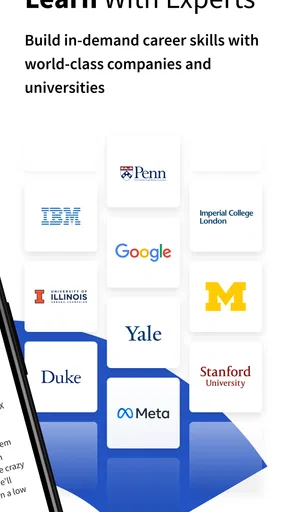
So, what exactly is Coursera? In a nutshell, it’s an online learning platform that offers a wide array of courses from top universities and companies worldwide. Think of it as your digital gateway to an Ivy League education without the hefty price tag. Seriously, we're talking about courses from institutions like Stanford and Yale, and companies like Google and IBM.
Diving Into the Features
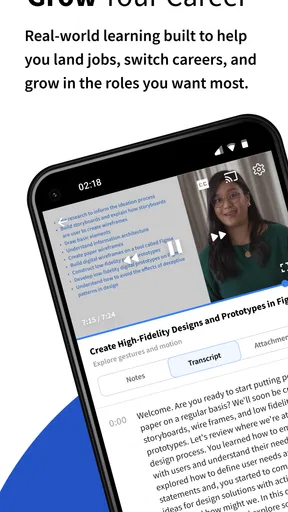
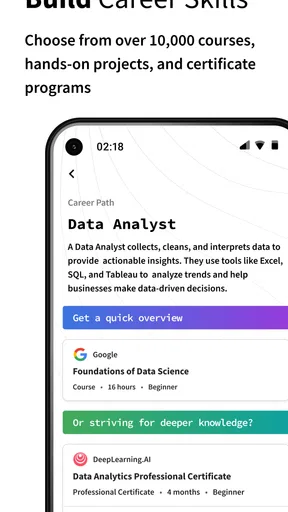
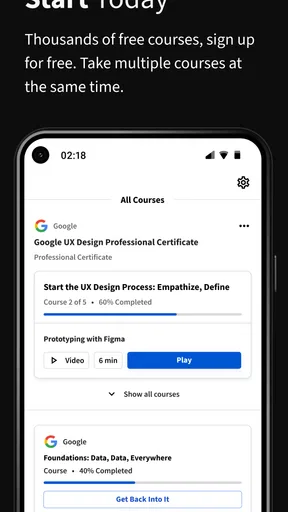
The first thing that caught my eye when I opened the app was its sleek and intuitive design. Navigating through the platform was a breeze, even for someone who's not exactly a tech whiz. You can easily search for courses by subject, university, or even the skills you want to learn. It feels like having a personal tutor in your pocket.
Once you pick a course, you’ll find a well-structured syllabus that guides you through the material. The best part? The flexibility. You can learn at your own pace, which is a lifesaver if you're juggling a hectic schedule. No more stressing about missing a class or falling behind.
The Learning Experience
Now, onto the meat and potatoes – the learning itself. Each course combines video lectures, readings, and quizzes to reinforce your understanding. I loved the interactive elements; they kept me engaged and made the learning process enjoyable. Plus, the discussion forums were a treasure trove of insights, allowing you to connect with fellow learners worldwide.
The quality of content is top-notch. The professors are experts in their fields, and it shows. They break down complex topics into bite-sized, manageable chunks, making it easier to grasp and apply the knowledge in real life.
Certificates and Career Impact
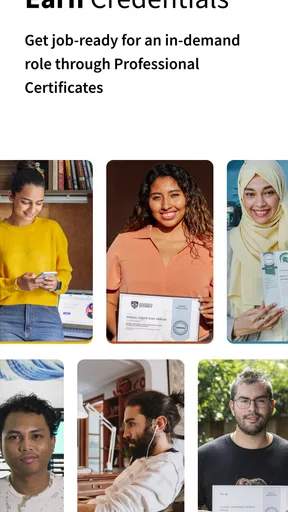
One of the biggest draws for me was the certification option. Completing a course earns you a certificate that you can proudly display on your LinkedIn profile or resume. It’s not just about bragging rights; these certificates can genuinely enhance your career prospects. Many employers recognize and value Coursera certifications, making you a more attractive candidate.
This platform also offers professional certificates and degree programs that can really set you apart in the job market. Whether you're looking to switch careers or climb the ladder in your current field, Coursera provides the tools to help you succeed.
Final Thoughts
So, is Coursera worth your time and effort? Absolutely. It’s like having access to a treasure trove of knowledge and opportunities at your fingertips. Whether you're looking to acquire new skills, pivot to a different industry, or simply quench your thirst for knowledge, Coursera could be the stepping stone you need.
Give it a shot and see where it takes you. Who knows? You might just find the career boost you've been searching for.
Privacy and Permissions
See what permissions an app requests and how it handles your data.
- Calendar
- read calendar events plus confidential information, add or modify calendar events and send email to guests without owners' knowledge
- Photos/Media/Files
- read the contents of your USB storage, modify or delete the contents of your USB storage
- Storage
- read the contents of your USB storage, modify or delete the contents of your USB storage
- Camera
- take pictures and videos
- Microphone
- record audio
- Wi-Fi connection information
- view Wi-Fi connections
- Other
- view network connections, full network access, change your audio settings, run at startup, reorder running apps, draw over other apps, control vibration, prevent device from sleeping, toggle sync on and off, read Google service configuration
Verdict
Strengths of Coursera: Grow your career
- Wide range of courses available.
- Courses from top universities.
- User-friendly interface.
- Certificates upon completion.
- Flexible learning schedule.
Limitations of Coursera: Grow your career
- Some courses can be expensive.
- Limited free content options.
- Course quality varies.
- Internet required for access.
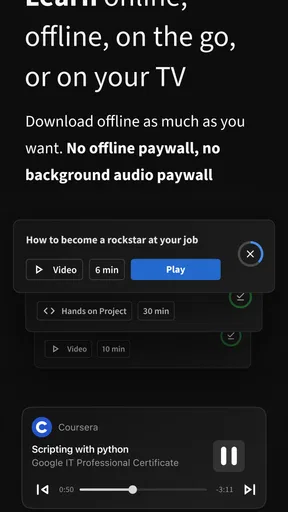
- No offline download for videos.
Similar Picks in This Category
View All
Duolingo: Language Lessons
Duolingo4.7

Google Classroom
Google LLC2.8

Unacademy: Learn & Crack Exams
Unacademy3.2

Bible App for Kids
Life.Church4.4

Cake - Learn English & Korean
Cake Corp.4.7

Brainly: AI Homework Helper
Brainly4.5
Frequently Asked Questions
What types of courses are available on Coursera?
Coursera offers a wide range of courses across various fields such as business, technology, data science, arts, and humanities. Users can find everything from short courses and specializations to professional certificates and degree programs. The platform partners with top universities and organizations to provide high-quality content.
Is there a cost associated with using Coursera?
While Coursera offers many free courses, access to graded assignments and certificates typically requires a fee. Prices vary depending on the course or specialization. Some financial aid options are available for those who qualify, allowing greater accessibility to its premium content.
Can I earn a degree through Coursera?
Yes, Coursera partners with universities to offer accredited degree programs online. These range from bachelor’s to master’s degrees in various fields. Degree programs are designed to be flexible for working professionals and offer the same quality education as on-campus programs.
How flexible is the course schedule on Coursera?
Courses on Coursera are designed to be flexible, allowing users to learn at their own pace. While some courses have set deadlines, many offer the option to reset deadlines based on personal schedules. This flexibility makes it ideal for those balancing work, study, and personal commitments.
What is the learning experience like on Coursera?
The learning experience on Coursera is highly interactive and engaging. Courses include video lectures, peer-reviewed assignments, community discussion forums, and quizzes. This structure is designed to cater to different learning styles, providing a comprehensive and adaptive educational experience.
